
Black Water When You Bleed a Radiator? Here's What It Means
Key points
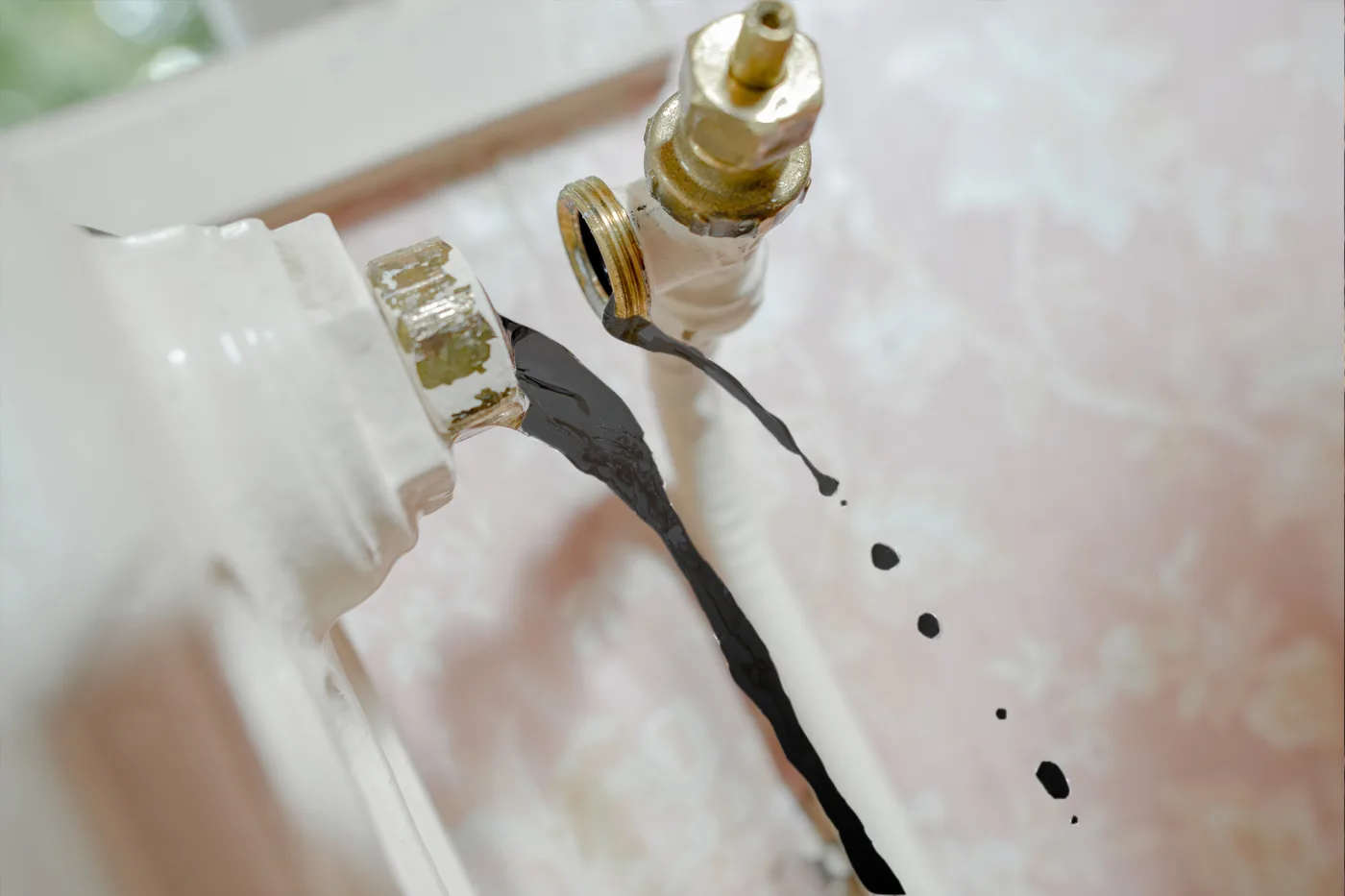
- Black water when you bleed a radiator is magnetite sludge. It is caused by corrosion inside the steel radiators and pipework.
- It is not an emergency, but it will not clear up on its own and it gets worse.
- The sludge settles in radiators and narrow pipework, which is why you get cold patches at the bottom and rooms that never quite warm up.
- Bleeding again will not fix it. Inhibitor slows further corrosion but does not remove sludge that has already formed.
- A power flush removes it. AR Heating charges a fixed £495 including VAT across the North East.
When you bleed a radiator you expect a hiss of air and maybe a little clear water. If what comes out is black, brown or rusty coloured, the heating system is corroding inside and the debris is circulating round it.
What is the black water in my radiator?
The dark colour is magnetite. Central heating water slowly attacks the steel inside radiators, and the iron oxide that produces mixes with the water to form a dark, gritty sludge. Left alone it keeps building, because every bit of corrosion makes the water more aggressive.
It is worth knowing that this is normal wear rather than anything you have done wrong. Any sealed heating system will do it eventually. What decides how quickly is whether the system was cleaned and dosed with inhibitor when it was installed, and whether that inhibitor has been topped up since.
What the colour tells you
| What comes out | What it means | How urgent |
|---|---|---|
| Clear water, small amount | Normal. The system is protected and circulating. | None |
| Cloudy or slightly grey | Corrosion starting. Inhibitor is probably low or absent. | Test and dose it now |
| Rusty orange or brown | Active corrosion, and often air getting in somewhere. | Get it looked at |
| Black, gritty water | Established magnetite sludge, circulating through the boiler. | The system needs cleaning |
| Black water and no heat at the bottom | Sludge has settled and is blocking circulation in that radiator. | Book a flush |
Not sure how bad yours is? Tell us what came out and how the radiators are heating, or call 0191 540 2051, and we will tell you whether the system needs cleaning or just an inhibitor top up. Ask us about it.
Why does it matter?
The sludge does not sit still. It is pumped round the system with everything else, and it causes problems in three places.
In the radiators. It is heavier than water, so it drops out at the bottom of each radiator and builds up. That is what causes cold patches at the bottom while the top stays hot, and why one or two rooms never get properly warm.
In the pipework. A lot of houses around Sunderland and Washington are on microbore pipe, which is narrow enough that sludge restricts it quickly. We see this constantly. There is more on it in microbore pipework and why Washington boilers block up.
In the boiler. This is the expensive one. Sludge passing through the heat exchanger wears it and can block it, and a blocked heat exchanger is often the repair that decides whether a boiler is worth keeping. It also makes the boiler work harder for the same heat, so the gas bill goes up before anything actually fails.
Can I just keep bleeding it?
No, and it tends to make things worse. Bleeding releases air, and every time you bleed and then top the system back up you introduce fresh water, which carries fresh oxygen, which feeds the corrosion. If you are having to bleed the radiators often, that is a separate warning sign in itself, because a sealed system should not need it regularly.
Will inhibitor fix it?
Inhibitor is a chemical that slows corrosion, and every system should have it. But it is a preventative. It will not dissolve sludge that has already formed, so topping it up on a system that is already running black is closing the gate after the horse has gone.
If the water is only slightly cloudy, testing and dosing the inhibitor is often all that is needed. If it is black, the system needs cleaning first and dosing afterwards.
What actually fixes it?
A power flush. High flow water and a cleaning chemical are circulated through the system, radiator by radiator, to lift the sludge off the surfaces and carry it out. The system is then refilled, dosed with fresh inhibitor, and usually fitted with a magnetic filter to catch anything that circulates afterwards.
On a badly blocked system individual radiators sometimes have to come off and be flushed outside, which is messy but is the only way to shift a radiator that has solidified at the bottom.
What does it cost to put right?
We charge a fixed £495 including VAT for a power flush across Sunderland, Durham, Houghton le Spring, Washington and the wider North East. That is the price whatever we find, so there is no bill that grows on the day.
An inhibitor top up on a system that is only slightly discoloured, or fitting a magnetic filter on its own, costs considerably less. We quote those once we have seen the system, because it depends on what is already fitted.
What we will not do is sell you a flush you do not need. If the water is cloudy rather than black, we will tell you to dose it and leave it alone.
Black water in your radiators?
We check the system before recommending anything. If a power flush is the right answer you get a fixed price up front, and if it is not we will say so. Gas Safe registered, covering Sunderland, Durham, Houghton le Spring, Washington and the wider North East.
See power flushing prices Call 0191 540 2051How do I stop it coming back?
- Keep the inhibitor topped up. It depletes over time and after any work that drains the system. It should be checked at every service.
- Fit a magnetic filter if there is not one, and have it cleaned out annually. It catches the metallic debris before it reaches the boiler.
- Have the system drained properly if a radiator is changed, rather than topped back up and forgotten.
- Get the boiler serviced every year. The inhibitor check and the filter clean are part of it, and it keeps the warranty valid.
Common questions
Is black radiator water dangerous? Not to you. It is dirty water inside a sealed system, not something you are breathing or drinking. The risk is to the boiler and the heating, not to health.
Does it mean I need a new boiler? Usually not. It means the system the boiler is attached to needs cleaning. Fitting a new boiler onto a sludged system without cleaning it first is how people end up replacing a boiler twice.
How long does a power flush take? Most houses are a full day. A larger system, or one where radiators have to come off, can run longer.
Will it fix my cold radiators? If they are cold because of sludge, yes. If a radiator is cold for another reason, such as a stuck valve or air, a flush is the wrong fix, which is why we look before we quote.
Where to go next
Black or brown radiator water is a sign the system needs checking rather than simply bleeding again. Read about our main power flushing service, or go straight to your local page for power flushing in Sunderland, Durham, Houghton le Spring or Washington.
If the boiler itself is also locking out, losing pressure or failing to heat properly, see boiler repairs rather than assuming sludge is the only cause.
Not sure we reach you? Call 0191 540 2051 and we will tell you in seconds.
About the author
Alex Robson is a Gas Safe registered heating engineer and the owner of AR Heating & Gas, based in Houghton le Spring and working across Sunderland, Durham, Washington and the wider North East. Last updated 12 October 2026.